Skip to content
W3 SolutionzACADEMY

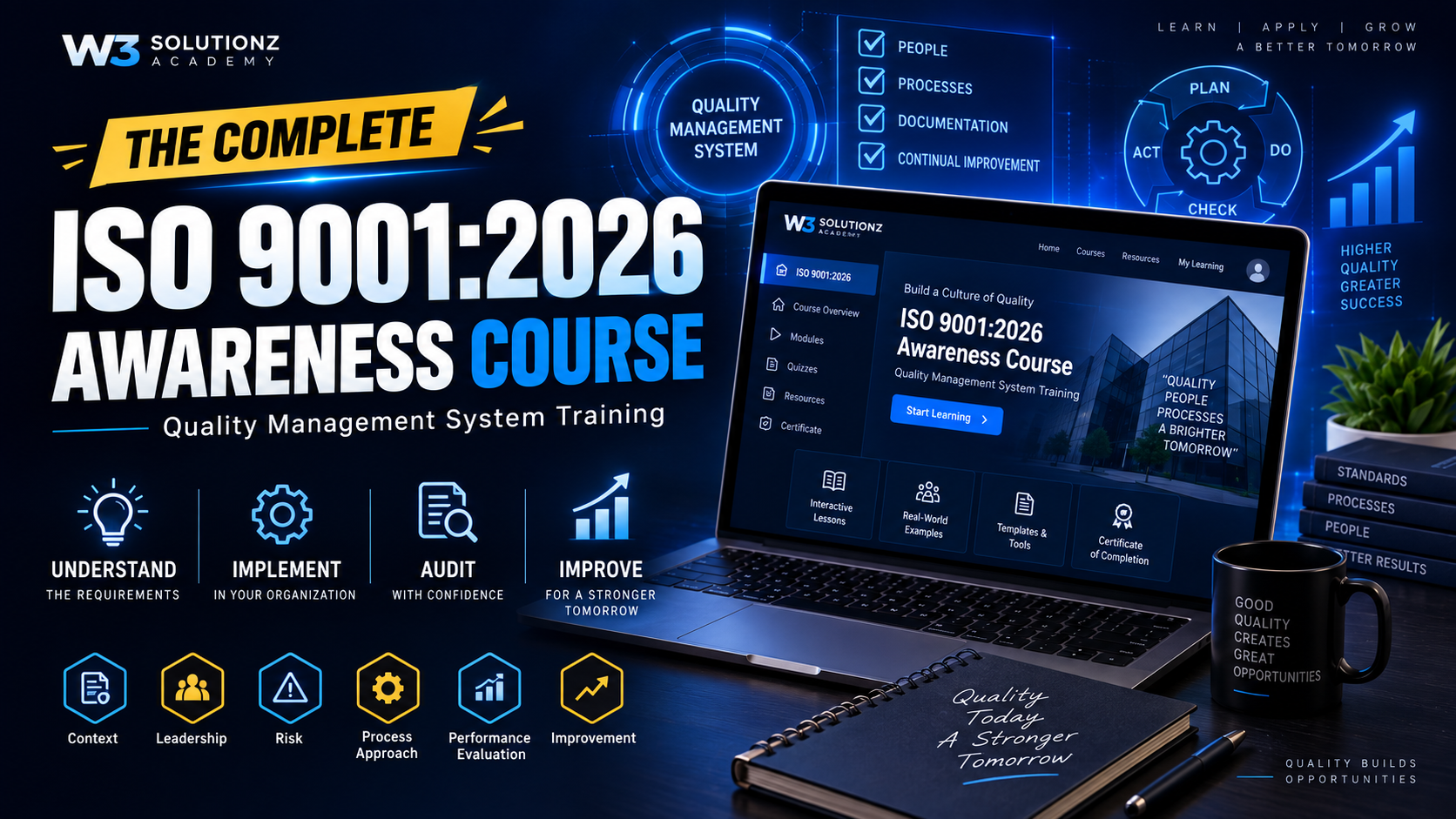
ISO 9001:2026 Quality Management Systems Awareness

Categories: Quality and Auditing
Wishlist Share

Share this course

Help a colleague take their next step.

About Course

Understand ISO 9001:2026 through 12 modules covering clauses 1 to 10, quality culture, ethical behaviour, risks and opportunities, and practical workplace decisions. This self-paced text course includes 36 lessons with activities and feedback, a 40-question final quiz and a case assignment. Estimated workload: 6.5 hours. Successful learners receive a W3 course completion certificate.

What Will You Learn?

  • LO01: Explain the purpose of ISO 9001 and the verified themes of the published 2026 edition.
  • LO02: Apply the quality principles, process approach and PDCA cycle to a workplace example.
  • LO03: Identify relevant context, interested-party requirements and QMS scope considerations.
  • LO04: Recognise leadership, customer focus, quality culture and ethical behaviour in practice.
  • LO05: Propose actions for risks, opportunities, quality objectives and planned changes.
  • LO06: Identify suitable resources, competence, communication and documented-information controls.
  • LO07: Explain operational planning, customer-requirement review and design controls.
  • LO08: Select appropriate controls for external providers, delivery, release and nonconforming outputs.
  • LO09: Interpret performance information and explain internal audit and management review.
  • LO10: Distinguish correction, cause investigation, corrective action and effectiveness review.
  • LO11: Outline a proportionate transition and QMS improvement approach using verified information.
  • LO12: Prepare a practical quality response and a measurable workplace action plan.

Course Content

Welcome and the 2026 edition
Understand the course, the purpose of a QMS and the verified revision themes.

  • Start here: your learning journey
  • What ISO 9001 does: clauses 1, 2 and 3
  • What the published 2026 revision changes

Quality principles and process thinking
Apply the seven principles, map a process and use the PDCA cycle.

Clause 4: Context and scope
Connect business conditions, interested parties and QMS boundaries.

Clause 5: Leadership and quality culture
Translate leadership, customer focus, ethics and policy into daily behaviour.

Clause 6: Planning
Plan actions for risks, opportunities, objectives and changes.

Clause 7: Support
Provide resources, competence, awareness, communication and controlled information.

Clause 8: Planning, customers and design
Control requirements from the first enquiry through product or service design.

Clause 8: Suppliers, delivery and release
Control external providers, delivery, release and nonconforming outputs.

Clause 9: Performance evaluation
Use meaningful data, internal audits and management review.

Clause 10: Improvement
Respond to problems, investigate causes and check lasting improvement.

Applying the QMS and planning transition
Bring the clauses together and prepare a practical transition plan.

Assessment and workplace application
Consolidate learning, complete the assignment and prepare for the final quiz.

Assessment

Student Ratings & Reviews

No Review Yet
No Review Yet