
Skip to content
W3 SolutionzACADEMY

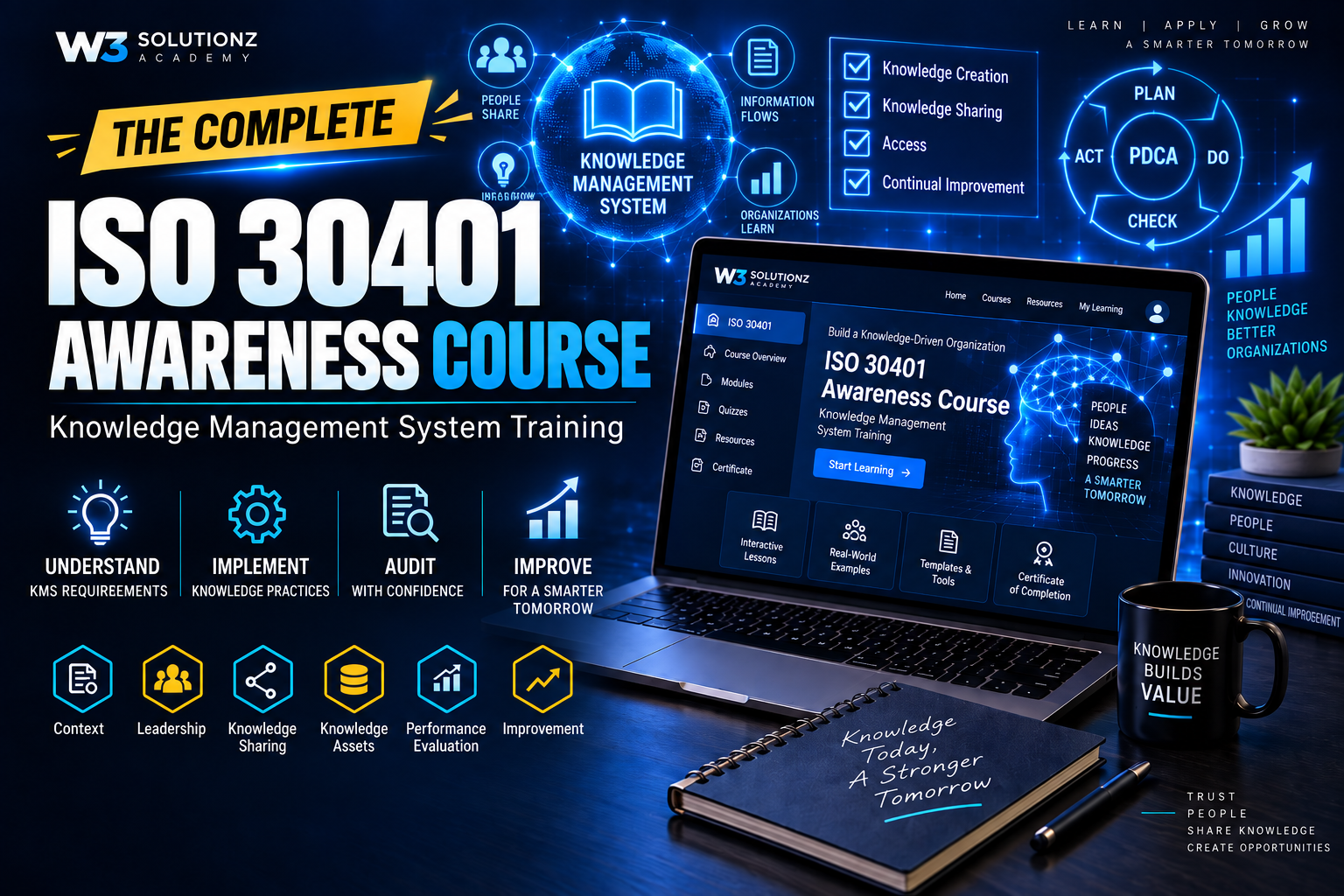
ISO 30401:2018 Knowledge Management Systems Awareness

Categories: Knowledge Management
Wishlist Share

Share this course

Help a colleague take their next step.

About Course

Build practical awareness of ISO 30401:2018, including the 2022 terminology and 2024 climate amendments, through 12 modules and 36 complete text lessons. Identify critical knowledge, understand leadership and culture, plan for knowledge risks, and develop, share, apply and retain useful know-how. Learn how competence, communication, controlled information, handovers, technology, access and AI-assisted work affect reliable knowledge use. Evaluate coverage, retrieval and operational results using worked examples. Every lesson includes an activity and feedback. A fictional service-organization case leads into a 40-question quiz and an assessed practical assignment with a marking rubric. Estimated workload: 6.5 hours. Successful completion earns a W3 course-completion certificate.

Show More

What Will You Learn?

  • LO01: Explain the purpose of ISO 30401 and recognize different forms of organizational knowledge.
  • LO02: Identify relevant context, interested-party needs, system boundaries and critical knowledge.
  • LO03: Describe how leadership, culture, roles and enabling conditions support knowledge management.
  • LO04: Formulate a knowledge risk, a measurable objective and a practical action plan.
  • LO05: Explain how useful knowledge is acquired, applied, retained and kept current.
  • LO06: Select suitable approaches for interaction, capture, synthesis and learning through practice.
  • LO07: Apply basic competence, awareness, communication and information-control practices.
  • LO08: Embed knowledge activities in reviews, communities, handovers and supplier relationships.
  • LO09: Recognize retrieval, confidentiality, intellectual-property and AI-related knowledge risks.
  • LO10: Calculate and interpret knowledge coverage, retrieval success and operational outcome measures.
  • LO11: Explain the contribution of internal audit, management review and corrective action.
  • LO12: Use case evidence to recommend prioritized actions and an evidence-based improvement plan.

Course Content

Knowledge management foundations
Recognize knowledge in everyday work, understand ISO 30401 and distinguish an effective management system from a document store.

  • 01 | Why knowledge management matters
  • 02 | Data, information and knowledge in practice
  • 03 | The standard, amendments and improvement cycle

Context, interested parties and scope
Connect organizational circumstances and climate relevance to knowledge needs, interested parties, critical topics and a useful scope.

Leadership, culture and responsibility
Turn leadership commitments into decisions, encourage constructive sharing and assign responsibilities across the knowledge management system.

Risks, objectives and action plans
Describe knowledge risks and opportunities, set meaningful objectives and organize proportionate actions and changes.

Developing and maintaining knowledge
Acquire and create knowledge, test its application, retain critical capability and handle outdated material.

Sharing and transforming knowledge
Select interaction, capture, synthesis and practice methods that transfer useful understanding across people and teams.

People, communication and controlled information
Build competence and awareness, communicate changes and keep knowledge resources identifiable, reliable and usable.

Knowledge in operational work
Use reviews, communities, handovers and external relationships to make knowledge part of normal delivery.

Technology, protection and responsible AI use
Improve retrieval, manage access and intellectual property, and check AI-assisted knowledge before reuse.

Measuring knowledge management results
Balance activity and outcome evidence, calculate coverage and retrieval measures and interpret performance trends honestly.

Audit, management review and improvement
Trace evidence, support management decisions and distinguish immediate correction from effective corrective action.

Integrated case and personal application
Evaluate a fictional service organization, propose a practical response and prepare for the final assessment and assignment.

Assessment