Skip to content
W3 SolutionzACADEMY

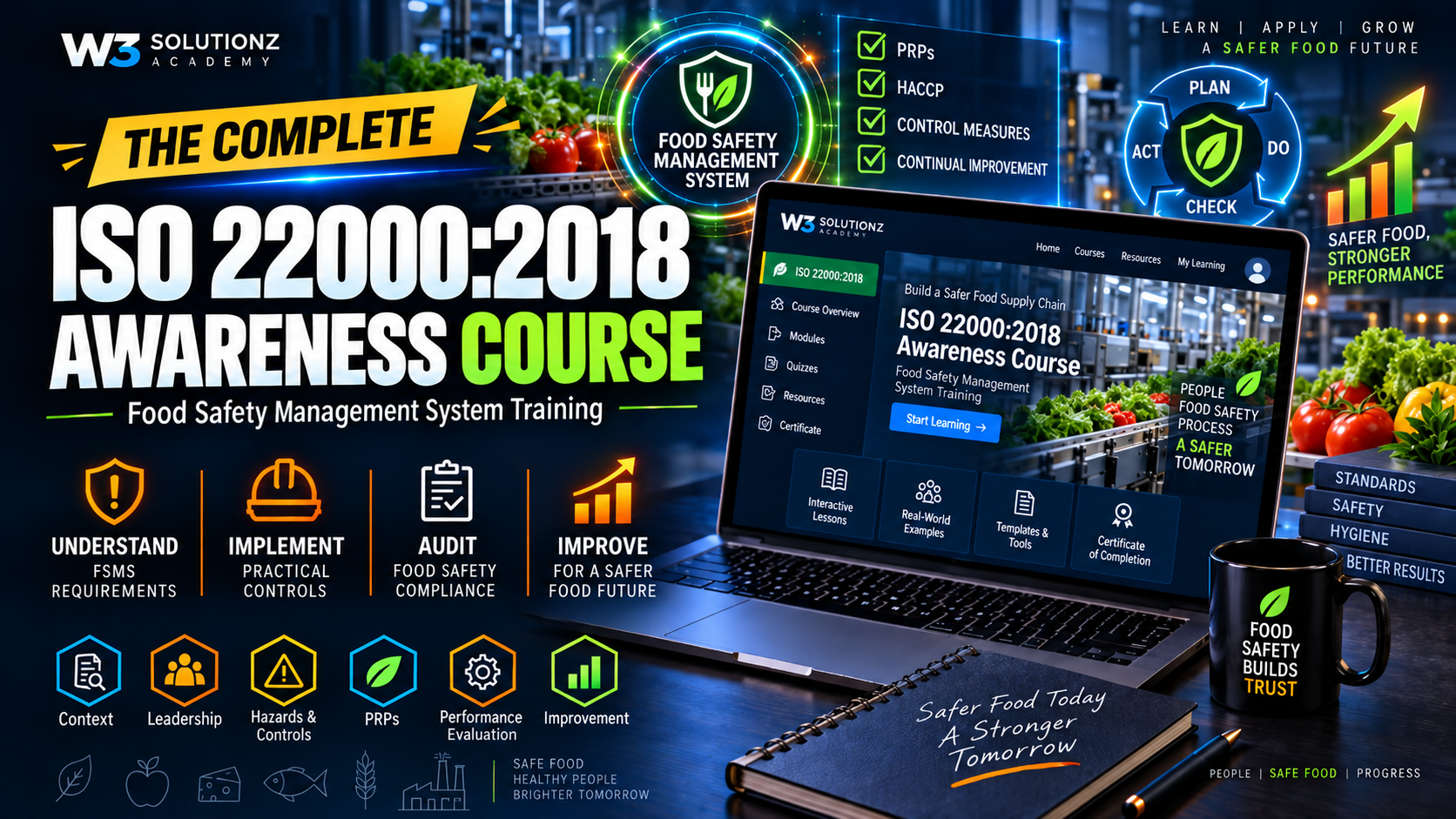
ISO 22000:2018 Food Safety Management Systems Awareness

Categories: Food Safety and HACCP
Wishlist Share

Share this course

Help a colleague take their next step.

About Course

Build practical awareness of ISO 22000:2018, including the 2024 climate amendment. Twelve modules and 36 complete text lessons cover FSMS leadership, hygiene and PRPs, traceability, hazards, OPRPs and CCPs, validation, monitoring, verification, product control, withdrawal and recall, audit and improvement. Every lesson includes an activity and feedback. Complete a 40-question quiz and a practical case assignment with assessor feedback. Estimated workload: 6.5 hours. Successful completion earns a W3 course completion certificate.

What Will You Learn?

  • LO01: Explain FSMS purpose, food safety terminology, HACCP principles, PDCA and the edition basis.
  • LO02: Connect context, climate relevance, leadership, responsibilities, objectives and planned changes.
  • LO03: Recognize resource, competence, communication, supplier and documented-information needs.
  • LO04: Explain prerequisite programmes, hygiene, allergen controls and sector-specific PRP selection.
  • LO05: Explain traceability, quantity reconciliation and food safety emergency preparedness.
  • LO06: Use product and process information to recognize hazards, acceptable levels and significance assessment.
  • LO07: Distinguish PRPs, OPRPs and CCPs, their criteria, and validation of control measures.
  • LO08: Explain monitoring, corrections, potentially unsafe product control and corrective action.
  • LO09: Distinguish updating, measurement assurance, verification, withdrawal and recall.
  • LO10: Interpret performance information and explain internal audit and management review.
  • LO11: Connect continual improvement and FSMS updating to practical food-chain decisions.
  • LO12: Prepare an evidence-based case response and a role-appropriate workplace action proposal.

Course Content

Welcome and food safety foundations
Purpose, food-chain application, HACCP principles, terminology and the 2018 edition with its 2024 amendment.

  • Start here: your learning journey
  • Food safety, the food chain and HACCP
  • Edition basis and the two PDCA cycles

Context, leadership and planning
Clauses 4 to 6: context and scope, policy, food safety team, system risks, objectives and changes.

People, communication and information
Clause 7: resources, competence, awareness, external support, communication and controlled information.

Prerequisite programmes in practice
Clause 8.2: effective hygiene foundations, contamination prevention and allergen management.

Traceability and emergency readiness
Clauses 8.3 and 8.4: linked records, quantity reconciliation, trace tests and emergency response.

Prepare and conduct hazard analysis
Clauses 8.5.1 and 8.5.2: materials, products, intended use, confirmed flow diagrams and significant hazards.

Select and validate hazard controls
Clauses 8.5.2.4 to 8.5.4: PRPs, OPRPs, CCPs, action criteria, critical limits and validation.

Monitor controls and respond to failures
Clauses 8.5.4 and 8.9.1 to 8.9.4: monitoring, correction, product disposition and cause-based action.

Verification, updating and recall
Clauses 8.6 to 8.8 and 8.9.5: current plans, reliable measurement, verification, withdrawal and recall.

Evaluate the management system
Clause 9: performance analysis, internal audit and management review.

Improvement and connected decisions
Clause 10: nonconformity, continual improvement, FSMS updating, integrated scenarios and terminology.

Assessment and workplace application
Practical assignment guidance, final quiz preparation, action planning and credible completion claims.

Assessment

Student Ratings & Reviews

No Review Yet
No Review Yet