
Skip to content
W3 SolutionzACADEMY

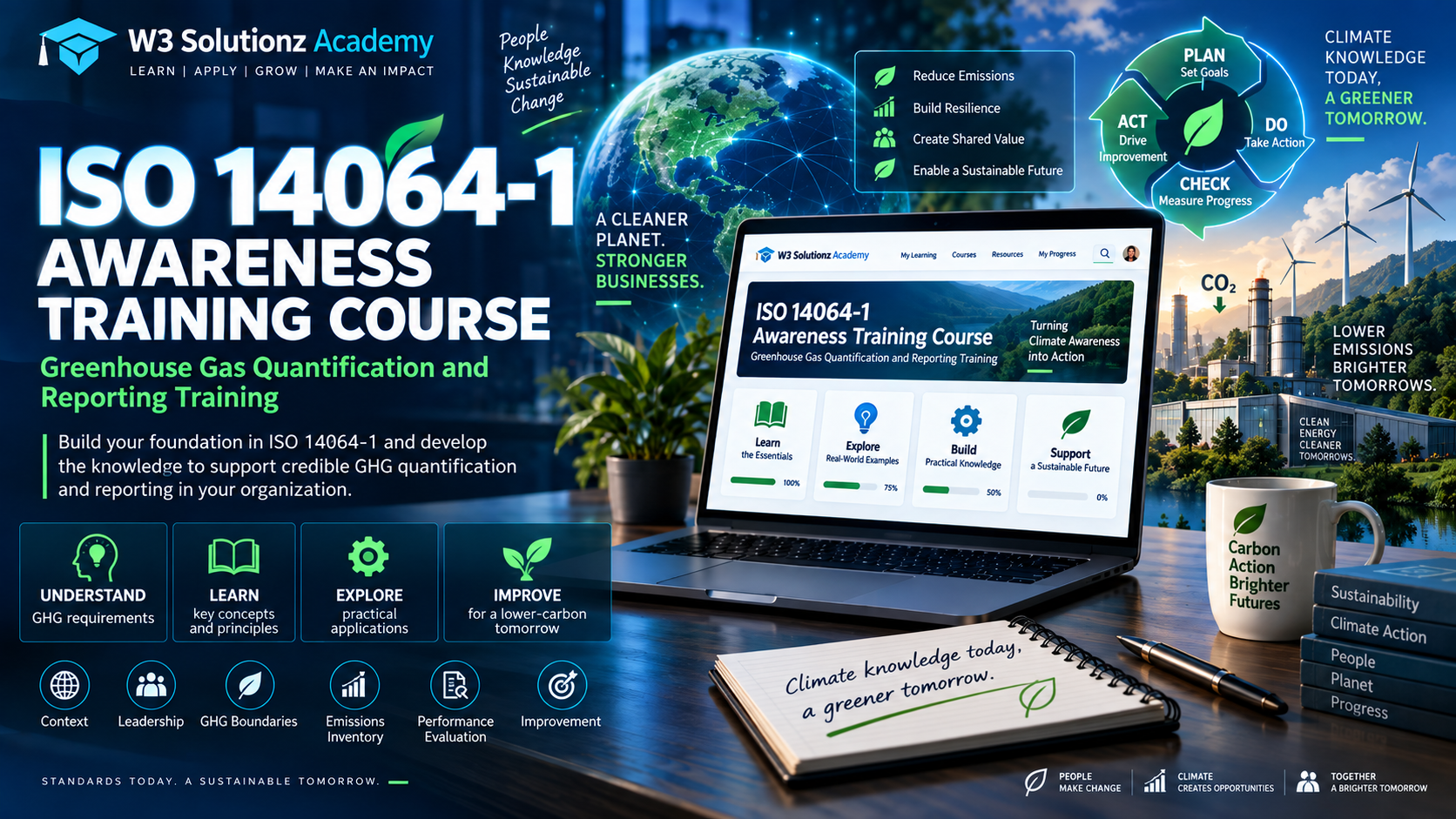
ISO 14064-1:2018 Greenhouse Gas Inventory Awareness

Wishlist Share

Share this course

Help a colleague take their next step.

About Course

Build practical awareness of organizational greenhouse gas inventories through 12 modules and 36 complete text lessons with activities and feedback. Learn inventory principles, organizational and reporting boundaries, six category groups, significant indirect emissions, data and factors, CO2e calculations, electricity, removals, biogenic carbon, base years, quality, uncertainty, mitigation, reporting and verification. Apply the fictional Seabrook Distribution case in a 40-question quiz and required practical assignment. Includes a separate learner assignment document and 12 optional reference links. Estimated learning workload: 6.5 hours. Successful completion earns a W3 course-completion certificate.

What Will You Learn?

  • LO01: Explain organizational GHG inventories and distinguish inventory, project and product purposes.
  • LO02: Apply the five inventory principles to intended uses, responsibilities and decisions.
  • LO03: Explain organizational consolidation using control or equity share and document boundary decisions.
  • LO04: Identify the six inventory categories and a reasoned process for significant indirect emissions.
  • LO05: Select traceable activity data and suitable emission factors with explicit units and limitations.
  • LO06: Calculate illustrative emissions in tonnes CO2e and explain electricity accounting and double-counting risks.
  • LO07: Distinguish emissions, removals, biogenic carbon, avoided emissions and external credits.
  • LO08: Explain base-year selection, recalculation and fair absolute and intensity comparisons.
  • LO09: Describe quality controls, record retention, missing-data treatment and uncertainty assessment.
  • LO10: Propose measurable mitigation actions and targets without overstating causation or neutrality.
  • LO11: Describe transparent reporting, internal review and the organization’s role in verification.
  • LO12: Evaluate the fictional inventory case, calculate results and propose accountable improvements.

Course Content

GHG inventory foundations
Explain the purpose, vocabulary and limits of an organizational inventory.

  • 01 | What an organizational inventory does
  • 02 | Gases sources sinks and CO2e
  • 03 | Inventory project and product boundaries

Principles and intended use
Apply relevance, completeness, consistency, accuracy and transparency.

Organizational boundaries
Understand control, equity share and boundary evidence.

Reporting boundaries and categories
Classify sources and assess significant indirect emissions.

Activity data and emission factors
Collect traceable data and select appropriate factors.

Quantification and electricity
Calculate CO2e and distinguish electricity accounting methods.

Removals and biogenic carbon
Recognize sinks, biogenic treatment and separate credit claims.

Base years and comparisons
Maintain comparable inventories and interpret changes.

Inventory quality and uncertainty
Control records, review calculations and explain uncertainty.

Mitigation and targets
Connect credible inventory evidence to practical action.

Reporting and verification
Prepare transparent reports and support verification.

Applied inventory case
Apply boundaries, calculations and quality controls to a fictional company.

Assessment

Earn a certificate

Add this certificate to your resume to demonstrate your skills & increase your chances of getting noticed.
selected template

Student Ratings & Reviews

No Review Yet
No Review Yet